Diagnostics, cleaning and software solutions for blocked diesel particulate filters, carried out mobile throughout the South East.
The Diesel Particulate Filter (DPF) is an emissions control device fitted to the exhaust system of all modern diesel vehicles. Its job is to trap soot and particulate matter produced during combustion, preventing it from being released into the atmosphere.
Under normal driving conditions the DPF clears itself through a process called regeneration. When exhaust temperatures reach a sufficient threshold, the accumulated soot is burned off and the filter resets. This is managed automatically by the ECU and happens without the driver noticing.
The problem arises when regeneration cannot complete. Short journeys, town driving and stop-start traffic all prevent the exhaust from reaching the temperatures needed. Over time, the filter blocks, and when it does, the consequences can be severe.
A heavily blocked DPF triggers limp mode, drastically cutting engine power to protect the vehicle. Performance becomes severely restricted until the fault is resolved.
A blocked or failing DPF commonly triggers multiple dashboard lights and stored fault codes. These will keep returning if the root cause is not addressed.
Repeated failed regeneration attempts inject raw fuel into the cylinder, which can find its way past the rings and dilute the engine oil, causing accelerated wear.
Back pressure from a restricted DPF forces the engine to work harder, and the additional fuel used during regeneration cycles results in noticeably worse economy.
Before any work is recommended, we carry out a full diagnostic assessment to read live DPF data, check soot loading levels and identify any underlying faults that caused the blockage. Understanding the root cause is essential, because clearing a DPF without resolving why it blocked will lead to the same problem returning.
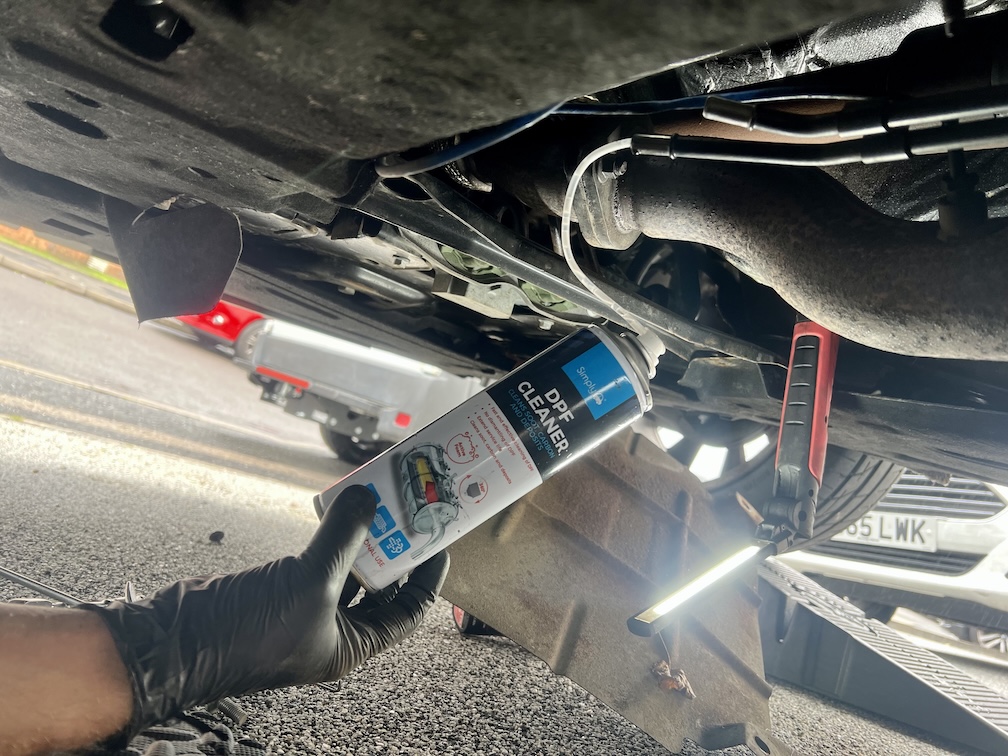
Where the filter is partially blocked and still serviceable, a forced regeneration can be triggered via specialist software to burn off accumulated soot and reset the system. A chemical cleaning treatment can also be applied directly to the filter to assist the process.
If a more involved software solution is appropriate for your situation, we can discuss the available options and advise on the most suitable course of action for your vehicle and how it is used.
The DPF was designed with the assumption that vehicles would regularly spend time at motorway speeds. In practice, a large proportion of diesel vehicles in the UK rarely leave town. Short school runs, local commutes and stop-start traffic all prevent regeneration from completing, meaning soot accumulates with every journey.
The result is a cycle of progressive blockage. The ECU triggers regeneration attempts but cannot finish them, and soot levels climb higher each time. When the filter reaches a critical load level, limp mode is activated, and at that point a standard forced regeneration may no longer be sufficient without first bringing soot loading down.
Main dealer replacement costs for a blocked DPF regularly run into four figures. In many cases the filter itself is not damaged, it is simply blocked. A correctly diagnosed and treated DPF can often be restored to normal function without the cost of a full replacement.
The DPF is an emissions control device required by law on diesel vehicles first registered after 2009. Under the Road Vehicles (Construction and Use) Regulations it is an offence to drive on a public road a vehicle that has been modified in a way that causes it to no longer meet its original emissions standard. Any software recalibration work we carry out is discussed with the customer in full beforehand, with road legality and intended use taken into consideration.
Mon – Fri: 8:30am – 5:30pm |
Sat & Sun: Closed
Call us: 07711 934 905
Mon – Fri: 8:30am – 5:30pm